
In brain-implant study, patient breaks through ‘dead end’
Since receiving an impulse-stimulation test device, a stroke patient has regained some fine-motor hand control.Media Contact: Susan Gregg - sghanson@uw.edu, 206-390-3226
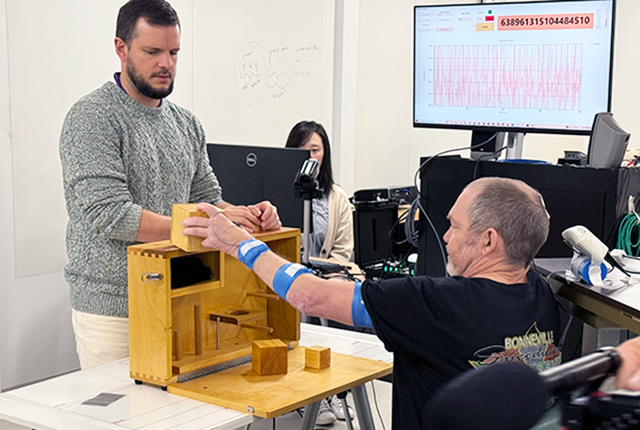
The first stroke patient enrolled in a safety trial for a device that stimulates their brain has regained significant muscle movement.
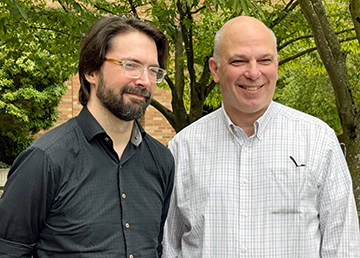
After a stroke, a loss of muscle movement can hinder people’s ability to do daily activities. Their options for recovery are limited. Dr. Jeffrey Ojemann, professor of neurological surgery, and Jeffrey Herron, associate professor of neurological surgery, both at the University of Washington School of Medicine, are hoping an implanted test device can change that.
On Memorial Day in 2021, Matt Kidd, 52, experienced his second stroke. When he woke up in the hospital, his left side was frozen.
“If I had to move my left arm, I would grab it with my right arm and place it,” he said.
For several years, he tried to recover his movement through rehab, but without much progress.
“I felt like I was at a dead end,” he said.
Then Kidd learned about the study. He wanted to enroll, and not only for his own sake.
“Throughout the entire study, Matt has been really committed to giving back to the stroke community that has supported him, and trying to do everything he can to make things better for other people who will be impacted by stokes in the future,” said Herron.
In July 2025, Kidd underwent brain surgery at Harborview Medical Center to implant the device, which consists of two soft, thin silicon sheets embedded with tiny electrodes. The sheets were placed on the surface of his brain over the area affected by the stroke.
Then, every weekday for six weeks, Kidd tried to perform certain movements during rehabilitation sessions while the electrodes emitted electrical impulses to induce neurons to fire together. The simultaneous firing of the neurons is thought to promote stronger connections between brain regions.
Although the device is no longer providing impulses, it will remain in Kidd’s brain for a few more months while doctors continue to monitor his progress. If it worked as intended, his brain connections should remain strengthened after stimulation stops and after the device is removed.
Kidd noticed improvements almost immediately after he began treatment. Now, over four months in, his fine-motor functions have advanced significantly. He has regained the ability to pick up a cup, put a nut on a bolt, and close the shower curtain.
“I’m finding myself not even realizing I’m doing things [I couldn’t before],” he said.
Observers have been surprised by the speed and extent of Kidd’s improvement.
“We are absolutely thrilled to see the first improvements of the patient in UW Medicine's clinical trial,” said Martin Schuettler, chief technical officer of CorTec, the device manufacturer.
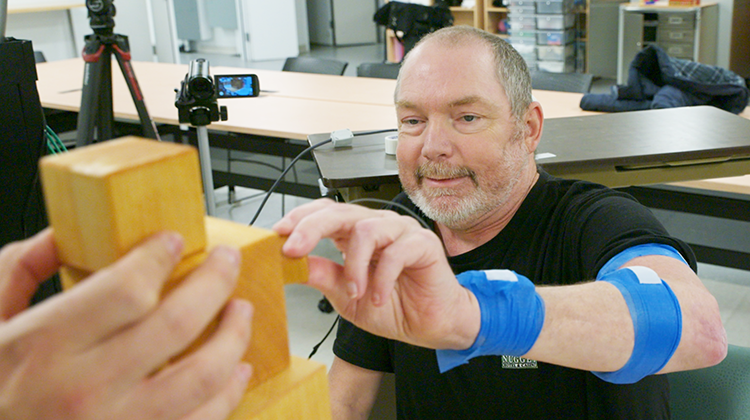
“It’s been extremely rewarding both for Matt and for the field,” said Ojemann.
The next stage of the study will focus on confirming the device’s effectiveness. The study is currently recruiting more patients.
Until then, Ojemann said, “Making something a standard part of therapy is a many, many year process. This is an extremely exciting start down that path.”
Written by Vishva Nalamalapu.
For news organizations: Download broadcast-quality video resources that include Herron, Ojemann and Kidd.
Related: Implant may help brain rewire after stroke
For details about UW Medicine, please see our About page.