
Supportive housing, care help resident keep demons at bay
A Seattle nonprofit and care from UW Medicine gave Randy Critz a foundation to escape substance-use disorder and regain a healthy life.Media Contact: Susan Gregg - 206-390-3226, sghanson@uw.edu
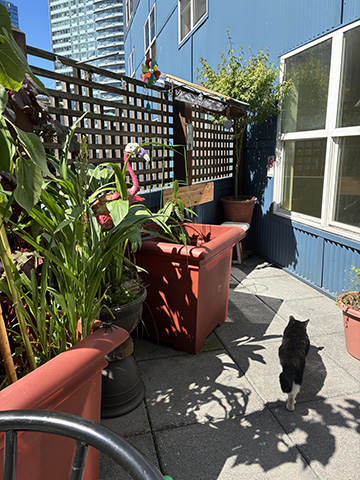
A supportive housing facility sitting next to I-5 in downtown Seattle might not be the first place you’d look for a brightly decorated, serene oasis.
Yet, on the second floor of the Downtown Emergency Service Center's 1811 Eastlake facility, that's what you’ll find: A balcony garden with sculptures, flowers, an avocado tree and a cat sunning himself.
Harborview patient Randy Critz has remade the space that used to be where residents discarded items. Now it offers a source of calm to the 72-year-old.
Much like the garden, Critz’s life has been transformed with careful tending. It’s a 20-year journey that has demanded both personal determination and care at Harborview Medical Center.
A place to call home
Founded in 2005, 1811 Eastlake houses 75 formerly homeless adults, all of whom have been diagnosed with chronic alcohol use disorders. It's built around an integrated care model where stable housing is combined with onsite medical and case management services, which contribute to a patient’s overall well-being.
Dr. Aynsley Duncan is associate medical director of Harborview Medical Center’s Downtown Programs, which includes 1811 Eastlake and 17 other field-based sites or programs.
The onsite medical team consists of just Duncan and two Harborview nurses, so all three team members take on a variety of duties. Duncan schedules her own appointments with patients and handles referrals, and sometimes even helps a visitor with parking in the building’s garage.
Despite the workload, Duncan says there are unexpected benefits. Like “seeing people living their lives, which is a true privilege,” she said. “The most rewarding part is really our patients, who are some of the most creative, resilient and hardworking people I've ever met.”
Of the 75 residents under her watch, some patients, especially new arrivals, require daily treatments for urgent problems like severe wound care. Other long-term residents, like Critz, whom she first began treating six years ago, require only periodic checkups for chronic conditions like diabetes and high blood pressure.
Duncan first met Critz in 2019 after the devastating loss of his partner of 16 years, Faye.
She was “quite a gal,” Critz recalled. They enjoyed mutual love of thrift stores and traveling. He especially remembers a road trip they took across 14 states, which ended up in Faye’s hometown on a Lakota reservation in South Dakota. It was her first trip back in 40 years.
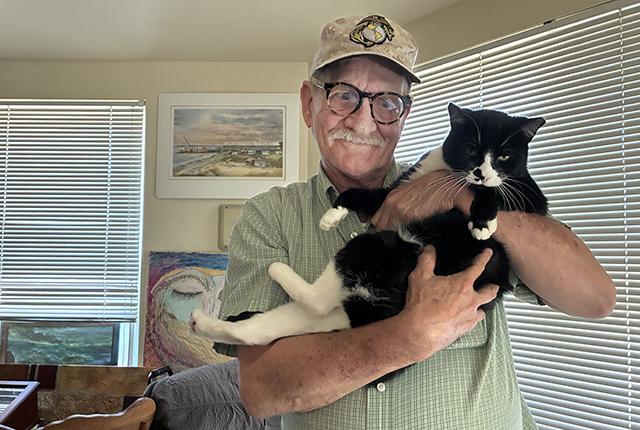
Critz’s room is adorned with photos of Faye, and the tuxedo cat purring on his lap, Pippin, was originally a gift for her.
Although he had already been in remission from substance use disorder for years, the grief of losing Faye made Critz reevaluate his life again. He wanted to honor her final advice to him: “No more fighting your demons.”
Breaking the cycle
Critz has known and battled many demons. He moved around a lot and experienced bouts of homelessness along the way, the memory of which makes his current recovery and stability feel even more precious.
A veteran and a former boxer, Critz escaped a difficult childhood in California by joining the Marine Corps in 1971. He was stationed in Hawaii for three years, and later moved to Tennessee, Nevada and then Washington. He worked as a restaurant kitchen manager, a tile and marble setter, and a fish processor. All the while, he struggled to keep away from alcohol and drugs.

“I'm a working guy, but I would screw a lot of these jobs up because I'd go out and get hammered,” he said.
He moved to Seattle in 2001 to try wild salmon fishing. It was an engaging job that offered plenty of time outdoors, but the same trouble followed him.
As far back as Critz can recall, every generation of his family has struggled with alcohol use disorder. His dad and grandfather had bouts of heavy drinking followed by rage and abuse.
Many medical experts who treat substance use disorder stress the importance of using appropriate clinical language to discuss the condition and its treatment in ways that combat the often-accompanying stigma. Duncan adds that this disorder — much like some types of cancer or heart disease — is a higher risk in some families.
Recognizing the similarities between himself and his dad, Critz tried many times to abstain. He made his way through “I don't know how many 12-step programs,” he said. “But I'd set myself up for failure each time. I would go to jail or end up in the hospital from blacking out."
Over the past decade, substance abuse disorder treatment has become more patient-centered. There are flexible approaches to addiction, such as harm reduction, which tries to mitigate detrimental results rather than demanding strict, total abstinence.
The harm-reduction approach is what keeps Critz’s disorder in remission. He has also quit cigarettes after 60 years — that final demon that Faye hoped he would vanquish.
Guardian of unfinished projects
Without the providers he’s worked with for decades at Harborview, he said, he might not be doing so well.
In 2007, he was hospitalized for a stroke that had caused temporary blindness in one eye. The care teams at Harborview have also treated his pneumonia, repaired a hernia, removed an appendix, performed colonoscopies and, recently, fixed an injured finger.
Along with improved physical health, Critz has found peace and purpose through his hobbies and his role as a respected elder.
His walls, interspersed with baseball memorabilia, showcase woodworking and craft tools. He also fixes neighbors’ furniture and appliances.
“He'll notify us if other residents in the building aren't doing well and tell us to go check on them,” Duncan said.
Critz has come a long way from when he first arrived at Harborview. And there are other gifts of recovery, too. He reformed his connection to estranged brothers and sisters and their now-grown children. Last Thanksgiving he stayed at his brother’s house for the holiday and got to meet fully grown nieces and nephews.
“I’ve never been better,” he says. “I’ve got my family back now.”
Written by Alexis Hauk, Harborview Medical Center
For details about UW Medicine, please see our About page.