
Film directs would-be rescuers when horse riders fall
A safety video will show bystanders and first-responders how to attend to a riding accident in an arena or on the trail.Media Contact: Susan Gregg - 206-390-3226, sghanson@uw.edu
It was supposed to be a routine training exercise. Taking the 3-year-old colt through his stops and starts, Ellensburg horse trainer Mitch Williams didn’t pay much attention to the weather at first.
Then the wind began, whipping the dust into mini tornadoes near his arena. Dust devils snapped up sagebrush and tumbleweeds, throwing debris into the arena.
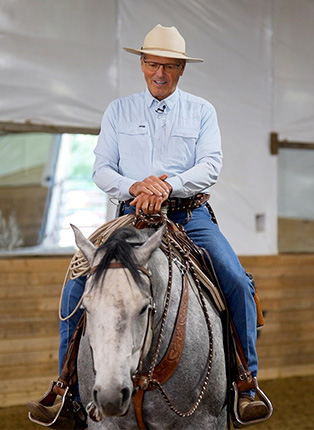
The colt lost it. He tried to jump the arena fence, with Williams in the saddle, caught both front legs in the slats and jackknifed. The horse, all 1000 pounds of him, landed squarely on Williams. A customer who had stopped by called 911, and Williams was airlifted to Harborview Medical Center. There he spent the next two months healing from 23 cracked ribs, a punctured lung and a damaged liver. Nine of those days were in the intensive care unit
It took months of recuperation and therapy, but Williams was determined to ride again — and to spread the message of equestrian safety.
“There are some things you just can’t prepare yourself for,” he said. “And first-responders have to turn off their sirens and lights. All those things can be distractions and, in some cases, spook the horses more, and more injuries might occur.”
It's one of the reasons that he supports a new UW Medicine educational film that aims to teach best practices for both bystanders and first-responders when an equestrian accident occurs.
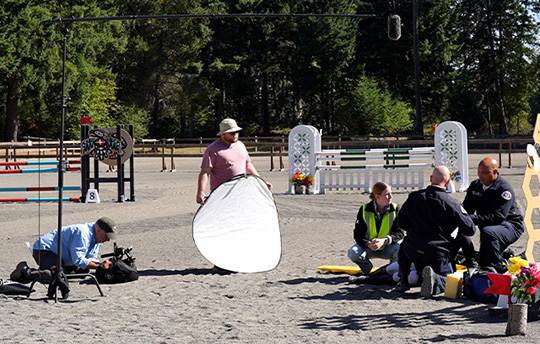
For the past year, staff at The Sports Institute at UW Medicine have worked with an independent film crew and Seattle Fire Department’s Medic One to show the correct way to approach an injured rider. The film is due out this year. Knowing what to do, and what not to do, in these moments is key, said Dr. Cindy Lin, an equestrian and sports medicine physician and director of The Sports Institute.
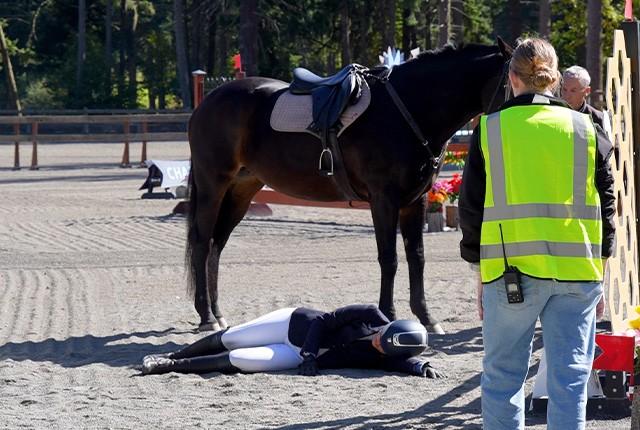
Last fall, Lin took a break from directing a video team at a Yelm riding arena. Videographers had taken shots of an ambulance coming into the complex, and the crew was focused on an “injured” rider who had just fallen from her horse. They were urging her to stay still while they checked her for head and spinal injuries.
“This is to help teach the layperson and also emergency medical services personnel what to do and what is unique about a horse accident,” Lin said. “Right now, this information doesn’t exist out there in a cohesive way.”
And, Lin added, it’s needed for this high-risk sport.
Lin’s prior publications have shown the significant risks associated with equestrian sports. Horseback riding results in more serious injuries and fatalities than many other high-impact or extreme activities. Head and neck injuries represent almost 75% of the cases in which riders have died. This emphasizes head and cervical-spine injury management by emergency-response teams.
“We know there are head and spinal injuries that can occur because you’re riding a 1000-pound animal at high speed in these events,” she said.
The safety video will be the third published by The Sports Institute; the first two focused on treating spine and concussion injuries from football and soccer, noted Scott Polovitch-Davis, its associate director.
“I think people don’t realize how many head trauma injuries come out of horseback riding,” Polovitch-Davis said.
A report by the American Orthopaedic Society for Sports Medicine noted that horseback riding is a leading cause of sports-related traumatic brain injury in the United States. A 2023 study of 210 equestrians found a higher incidence of concussion in equestrian sports than football or rugby.
“We hope this video saves lives,” Lin said. “We hope it empowers people to be calm when they’re in a crisis.”
This holds true for casual riders as well, said third-year Alaska WWAMI medical student Alyssa Randall, who was helping with the shoot last fall.
“You might freeze first when you see an accident happen in front of you, but the video gives good information on how to stabilize the rider, calling 911 and giving them instructions,” said Randall, who grew up around horses.
And even when everything seems controlled, routine and scripted, plans can go awry.
While film crews were shooting an ambulance (lights off) coming into the Yelm farm, one of the horses was spooked by a camera. No one was hurt, but point made: It can happen that fast—just like the dust devil that sent Williams to Harborview.
In looking back at his experience, Williams gave this advice:
“Horses are not pets,” he said. “We love them, can be friendly with them and enjoy them, but they can hurt you and you can get hurt. And the absence of knowledge is probably the leading cause of injury. If I were to say what one thing causes equestrian injuries, I'd say it's knowledge.”
Written by Barbara Clements.
For news organizations: Download broadcast-quality video resources with Cindy Lin and Mitch Williams.
Related video: Gameplan - Equestrian Safety and Emergency Response
For details about UW Medicine, please see our About page.