
Neuroscientist Astra Bryant named 2026 McKnight Scholar
Bryant studies parasitic roundworms whose heat-sensing abilities enable them to locate hosts to infest.Media Contact: Leila Gray, 206-475-9809, leilag@uw.edu

Soil-transmitted parasitic roundworms that find potential hosts by sensing body heat are the topic of research for Astra Bryant, one of 10 newly named 2026 McKnight Scholars. Bryant, an assistant professor of neurobiology and biophysics, joined the University of Washington School of Medicine faculty in 2023.
The McKnight Scholar Awards are granted to scientists who are in the early stages of establishing their own independent laboratories and research careers and who have demonstrated a commitment to neuroscience. Since its inception in 1977, the program has funded 301 researchers.
Bryant’s recent efforts have been to advance the scientific understanding of a neglected parasitic disease that affects over a billion people. Most are children living in tropical and subtropical climates in Asia, Africa and the Americas. Transmission is more common in low-resource communities with inadequate water and sanitation infrastructure.
Roundworms are also an unrecognized health burden in the United States. They can be transmitted on unwashed hands, and can penetrate the skin on the feet or other areas exposed to unsanitary conditions. Living in the gut, roundworms can contribute to malnutrition and stunt growth. The devastating infestation is sometimes fatal.
Bryant is approaching the problem by studying how the nervous systems of these parasites control their infestation behavior. The hope is to discover new strategies against roundworm disease.
Other scientists have observed that disease-causing roundworms, such as Strongyloides stercoralis, are remarkably similar to a harmless, well-studied nematode, Caenorhabditis elegans.
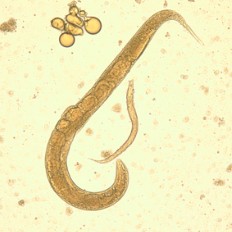
Her research takes advantage of that similarity. The different species have common, identifiable cell types. However, C. elegans avoids warm temperatures, while parasitic roundworms gravitate towards the warmth of a human body.
These parasites are analogous to heat-seeking missiles and move remarkably quickly (for nematodes) towards body heat, Bryant noted.
Not only do they use their thermal sensory systems to locate new hosts, but the parasitic worms are also able to survive and reproduce for many months inside the warm environment of human organs. The Bryant lab is interested in how this transition, from free-living soil organism to host-dwelling parasite, is supported by thermal cues.
The team would also like to learn if similar thermosensory adaptations evolved independently in other parasitic worms, such as hookworms.
Bryant and her team are trying to determine how relatively comparable nematode nervous systems give rise to the striking differences in behavior and physiology between parasitic roundworms and C. elegans.
As a scientist with the UW Medicine Healthy Aging and Longevity Research Institute, she is also interested in what contributes to the survival and longevity of the parasitic roundworms, in contrast to C. elegans, which has a much shorter lifespan at ambient temperatures.
Bryant has developed new methods to quantify and conduct mechanistic analyses of sensory-driven behavior and nervous system function in parasitic nematodes. Her lab also uses neural imaging and genomics tools, originally applied to research on the harmless C. elegans roundworm, to identify the specific molecular, cellular and neural adaptations that fashioned the thermosensory biology of heat-seeking parasitic worms.
“Our ultimate goal is to enable new prophylactic and therapeutic approaches to treating a major threat to global health and economic stability,” Bryant noted in her lab website.
Bryant’s past studies have explored a variety of neuroscience circuits and systems.
Her Ph.D. work, for example, sought to uncover the neural circuits underlying spatial attention. She sought to answer the question of why many psychiatric diseases often involve the same cluster of symptoms. These are disruptions of: gaze control, selective attention, cholinergic signaling (a neurotransmission system in the brain) and gamma (25-60 Hz) oscillations of local field potentials (repeating patterns of voltage changes).
One hypothesis is that this clustering of symptoms reflects neural mechanisms that are shared by all four phenomena. In the Stanford lab Eric Knudsen, renowned for many neurobiology advances with barn owls as a model, Bryant identified one such linkage: a cholinergic mechanism that directly couples increased gamma power to the computation of the highest priority location for gaze and attention in the midbrain spatial attention network of birds.
Bryant graduated from Bryn Mawr College, earned her Ph.D. from Stanford, and was a postdoctoral fellow in the UCLA lab of Ellisa Hallem, who studies sensory-driven behavior in nematodes.
For details about UW Medicine, please see our About page.