
Intensive screening, infection control can contain C. auris
Universal screening and rigorous sterilization measures ended a hospital's outbreak of the potentially fatal fungus.Media Contact: Susan Gregg - sghanson@uw.edu, 206-390-3226
When Harborview Medical Center in Seattle detected its first case of Candidozyma auris (C. auris, also known as Candida auris), it launched an intensive screening and infection control effort that halted the spread of the deadly fungus before it caused broad harm.
"We knew C. auris was coming to the region and the risk of an outbreak was high at Harborview, where we have many vulnerable patients and shared spaces, so our goal was to catch it early before it caused a big problem," said Dr. Chloe Bryson-Cahn, an infectious-diseases specialist at UW Medicine in Seattle and associate medical director of infection prevention at Harborview.
She is co-first author of a paper published Aug. 19 in the journal Clinical Infectious Diseases that describes the hospital's six-month campaign to stop the fungus.
C. auris was first detected in the United States in 2016. It has since spread to 41 states, causing more than 20,000 cases. So far this year, it has caused more than 3,400 cases nationwide, according to the U.S. Centers for Disease Control and Prevention.
It is particularly dangerous for severely ill patients, especially those connected to medical devices that give the fungus a way into the body, such as ventilators, catheters and arterial and venous lines. C. auris also often resists common antifungal drugs, complicating treatment. One CDC study found that invasive infections were associated with a death rate of more than 30%.
C. auris spreads easily through hospitals and nursing homes because it can live on human skin without causing symptoms, allowing patients and staff to carry it from place to place. It can also persist for weeks on surfaces such as bedding, bedrails, doorknobs and blood pressure cuffs.
Harborview is a 500-bed public hospital in King County, Washington, affiliated with the University of Washington School of Medicine. As an urban safety-net hospital with a Level I trauma center and a burn center, Harborview cares for many high-risk patients. Most of its rooms are double occupancy, and five units house six or more patients separated only by curtains.
Even before C. auris was detected in Washington state, UW Medicine had begun a surveillance program in which any Candida species found in urine cultures were tested for C. auris. The first Harborview case identified was a 37-year-old admitted after a cardiac arrest who had been in the hospital three weeks before testing positive for C. auris. This suggests the fungus was contracted during hospitalization.
Testing of patients who had been in the same unit the previous month found one other person positive for C. auris, a person who had been in the same room previously. That patient had polysubstance use disorder, had been homeless, and had been admitted to Harborview and another area hospital multiple times. "This was probably our true first case," Bryson-Cahn said.
Most hospitals currently limit screening to high-risk patients and areas where especially vulnerable patients receive care, such as intensive care units (ICUs). But a recent study found that the limited screening approach recommended by most guidelines misses most patients who carry the pathogen.
“Rather than waiting for it to spread to the ICU and cause harm in this vulnerable population, we started screening everyone intensively,” said co-first author Dr. Emily Helm, a UW Medicine resident physician in lab medicine and pathology.
That eventually meant collecting swab samples from all patients upon admission and weekly during their hospitalization.
Testing initially relied on a diagnostic method that required growing the swab sample in culture — a slow process that can take a week to yield results. To speed things, the team switched to a polymerase chain reaction (PCR) test, which still took nearly 38 hours from collection to result. By the outbreak's tenth week, the lab medicine and pathology team had developed its own PCR test that delivered diagnoses in just 20 hours. In all, the team ran 11,639 tests on 5,563 patients.
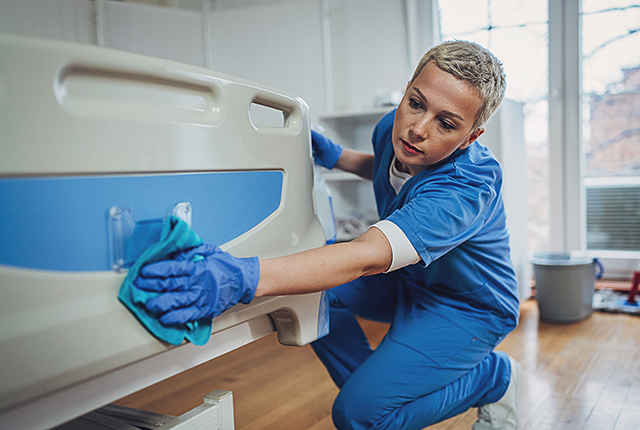
Infection-control measures included moving patients who tested positive for C. auris into single rooms, requiring staff to wear gowns and gloves when entering those rooms, and following strict sanitation protocols. When these patients were discharged, their rooms were cleaned twice with bleach solutions and sterilized twice with ultraviolet light.
After cleaning, surfaces were tested for the presence of any microbiological material using a device that detects adenosine triphosphate (ATP), a molecule found in all organisms. If ATP was detected, the room was cleaned again.
Additional measures included daily deep cleaning of hospital ICUs and ATP “audits" of high-use spaces and equipment, including wheelchairs and ultrasound machines.
"Transmission was halted only when we ramped up screening to '11' with universal PCR testing, alongside enhanced infection-prevention and -control interventions," said senior author Dr. Alexander Greninger, professor of laboratory medicine and pathology at the UW School of Medicine and head of UW Medicine's Division of Infectious Disease Diagnostics.
In all, the program identified 29 patients colonized with C. auris. Half of those who became colonized in the hospital had stayed in bed spaces previously occupied by colonized patients. None developed a symptomatic infection or required antifungal therapy. The county health department declared the outbreak over 23 weeks after the first case was identified.
For details about UW Medicine, please see our About page.