
Some antibodies outmaneuver germs from sticking to cells
The devious ways certain antibodies interfere with pathogen adhesion might suggest designs for novel infection therapies.Media Contact: Leila Gray - leilag@uw.edu, 206-475-9809, or mediarelations@uw.edu
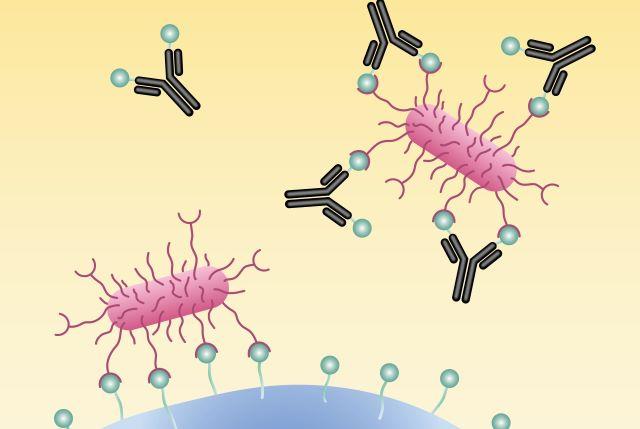
Pathogens can create sticky situations. When microbes invade the body to cause an infection, often one of their first lines of attack is to cling tenaciously to the surfaces of targeted human cells.
Certain antibodies employ unusual tactics to keep germs from attaching to cells in our bodies. Their defensive strategies could suggest novel ideas for next-generation infection preventions or treatments.
A recent study led by University of Washington School of Medicine researchers uncovered several new mechanisms by which antibodies block E. coli bacteria that cause urinary tract infections from attaching to bladder cells. Once E. coli bacteria get a strong grip, they can be difficult to flush out.
The antibodies used multiple, distinct interference schemes to overcome attempts by the bacteria to take hold. These include creating molecular wedges, conformational traps or pocket locks in the specialized attachment proteins that bacteria use to grab onto the human cells.
One mechanism appears to be represented in a newly recognized class of antibodies that mimic molecules on the cell surface. They use this deception to trick the bacteria into binding to them instead of bladder cells.
“All of these antibody mechanisms found in studying urinary tract infecting E. coli are likely applicable in defending against other bacterial and viral pathogens as well,” said Dr. Evgeni V. Sokurenko, a physician-scientist and professor of microbiology at the UW School of Medicine in Seattle and one of the senior researchers on the project.
The findings are published in Nature Communications. The co-senior and corresponding authors are Pearl N. Magala, acting instructor of biochemistry, who initiated the study, and Justin M. Kollman, professor and chair of biochemistry, both at the UW School of Medicine.
Many pathogens produce elaborate cell-attachment, or adhesion, proteins that enable them to figuratively glue themselves to receptor molecules on human cells.
The research team was fascinated to find that the E. coli’s bacterial cell-adhesion system was fooled by a decoy molecule linked to a crucial region of one of the antibodies they studied.
The antibody contained a glycan — a type of complex carbohydrate structure found on nearly all cell surfaces — that in this case mimicked the glycan-like receptor on human cells that the bacteria were seeking to latch onto. The bacteria would mistakenly bind themselves to these antibodies instead of living cells.
This false move both blocked the attachment and flagged the bacteria for killing by the immune system.
“This class of antibodies, which we propose calling 'glycanbodies,' is likely to be broadly produced in response to bacterial and viral antigens, or induced by vaccination,” Sokurenko noted.
Kollman confirmed the finding’s novelty and significance, saying: “While many antibodies are known to carry various forms of glycans, surprisingly, existence of antimicrobial antibodies with the cell receptor-mimicking glycans were not documented before.”
Kollman also pointed out certain microbial glycan-binding proteins, including the adhesion proteins found on E. coli, might potentially interact with a subset of cancerous B cells in lymphomas and cause tumor growth and persistence.
In addition, normal B cells are part of the body’s immune system. Thus, antigens from infectious microbes might contribute to autoimmune disorders by stimulating B cell receptors, the researchers noted.
The results of the study provide a starting point, the scientists noted, for the development of immune therapies that target glycan-binding cell-attachment proteins produced by bacteria that cause urinary tract infections. This approach might also be explored against other disease-related bacteria, viruses, pathogenic fungi and some parasites.
However, the researchers cautioned that actions of anti-adhesion antibodies might not always be beneficial for people or animals. These potential side effects should be kept in mind, they advised, in selecting the components to be tested in vaccine development.
The scientists used cryo-electron microscopy, mass spectrometry, adhesion assays, and molecular dynamics simulations on the Expanse supercomputer in San Diego to study the structural and functional aspects of antibody action against bacterial adhesion.
The research was supported by grants from the U.S. National Institutes of Health (F32 AI145111, R00 GM147304, K99 GM141364, R01 AI119675 R21 AI178593, R01 AI171570, R35 GM149542 and S10 OD023476).
For details about UW Medicine, please see our About page.