
Most insects slow down in bitter cold. Not snow flies.
Snow flies can continue to move even when their internal temperatures drop to minus 10 degrees Celsius. Scientists will explore why.Media Contact: Leila Gray - 206-475-9809, leilag@uw.edu
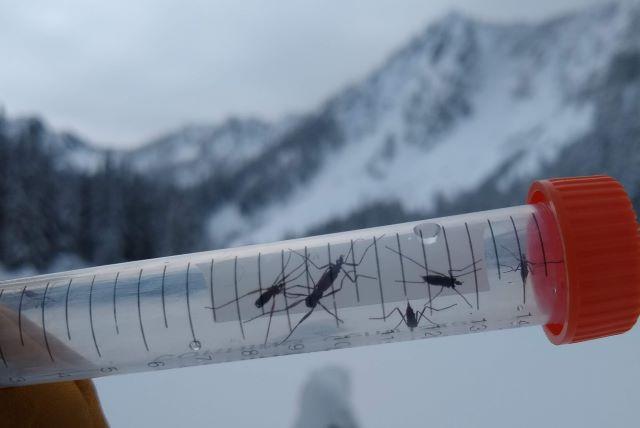
A bluebird afternoon is prime time for wingless adult snow flies to scurry along the fresh powder on mountain slopes in the hopes of finding a mate.
Subzero temperatures deter such pursuits among most insects, but snow flies hurry even as their internal temperatures drop. Bitter cold generally interferes with the biological processes that govern movement, thereby slowing down many animals.
John Tuthill’s neurobiology and biophysics lab at the University of Washington School of Medicine will collaborate with Sebastian Brauchi’s physiology lab at Universidad Austral de Chile to learn more about why snow flies have the unusual ability to carry out their chilly weather excursions. Snow flies can continue to move even when their internal temperatures drop to – 10 degrees Celsius.
The decrease in snowpacks and increased climate variability in the Pacific Northwest and across the planet will likely imperil snow flies and other animals that rely on snow for survival, Tuthill’s team noted in a 2023 snow fly paper in Current Biology.
“We may have limited time to study these species before they disappear altogether,” they wrote.
Tuthill and Brauchi are one of seven collaborative research pairs that were named 2025 Pew Charitable Trust Innovation Fund Investigators this week. The program champions interdisciplinary partnerships among alumni from its early-career biomedical scientist programs in the United States and beyond.
In 2019, Tuthill was one of 22 young scientists chosen as a Pew Scholar in the Biomedical Sciences for his team’s work on the body’s sense of its position and movements. The fruit fly was their model. The Tuthill lab also ran a citizen science program called The Snow Fly Project in which hikers, snowboarders and skiers collected these insects in the wild to help with research on the physiology of cold tolerance. The assistance of citizen scientists also provided new information on the habitats and ecology of snow flies.
Brauchi, Tuthill’s research partner on the new award, was a 2006 Pew Latin American Fellow. His lab studies the evolution of bioelectrical signals that allow cells to rapidly detect and respond to environmental information. The lab concentrates on ion channels – pores in cell membranes that transport charged particles, such as sodium or calcium ions. This flow of ions helps propagate electrical signals that control nerve and muscle functions.
In subzero temperatures, ion flow and protein movement dwindle, thereby affecting cell signal conduction necessary for nerves and muscles to communicate. Brauchi’s lab hypothesizes that snow flies may have evolved more flexible ion channels and pumps that continue to do their jobs at lower temperatures than most other insects can withstand.
His and Tuthill’s labs will perform electrophysiological recordings, protein sequence analyses, and measurements of cell membrane biophysical properties in subzero conditions. They hope such data will lead to a better understanding of how snow flies have adapted to sustain movement despite extreme cold. The research might also spawn similar studies on cold adaptation in other animals that stay active during frigid temperatures.
Snow flies are related to crane flies, the long-legged flying insects that swarm around lights on summer evenings. Although snow flies are wingless, they have club-shaped vibrating organs that help them check and correct their position, almost like a gyroscope. Females store their eggs in the space normally reserved for flight muscles in other flies.
Both sexes self-amputate frozen legs to protect the rest of their bodies from the fatal spread of ice. When they are not trekking on surface snow, they live in the debris between the snowpack and the ground. Their larvae likely ingest decaying plant material or small mammal scat.
Adults, which emerge in winter, do not eat but, according to the Tuthill lab, enjoy the occasional small sip of maple syrup.
For details about UW Medicine, please see our About page.