
Drug turns lung cells into slow-release antibiotic depots
The engineered therapy delivers an antibiotic inside lung immune cells, which then leak the drug to kill nearby bacteria.Media Contact: Susan Gregg - sghanson@uw.edu, 206-390-3226
A new designer drug that turns lung immune cells into slow-release antibiotic dispensers can clear a lethal pneumonia infection in mice, researchers report.
The approach, described Dec. 16 in the journal Antimicrobial Agents and Chemotherapy, may allow existing antibiotics to eradicate difficult-to-treat infections more effectively and with fewer side effects, said first author Ciana L. López.
“We used a standard antibiotic, but by changing how it is delivered, we were able to significantly improve clearance of bacteria from the lungs, reduce inflammation and prolong survival with a single dose,” López said.
López conducted the research in her doctoral studies at the University of Washington’s Department of Bioengineering in Seattle. She is now a postdoctoral researcher at Duke University in North Carolina.
In the study, López and colleagues created a compound known as a prodrug, an inactive form of a drug that becomes active only after being metabolized by the body. Prodrugs can be engineered to extend drug half-life, to ease storage and delivery — and to target specific cells or tissues.
The team’s goal was to create a prodrug that slowly released an antibiotic inside immune cells called alveolar macrophages. Macrophages are large cells that engulf and digest bacteria throughout the body. Alveolar macrophages are found in the lung’s tiny air sacs, the alveoli.
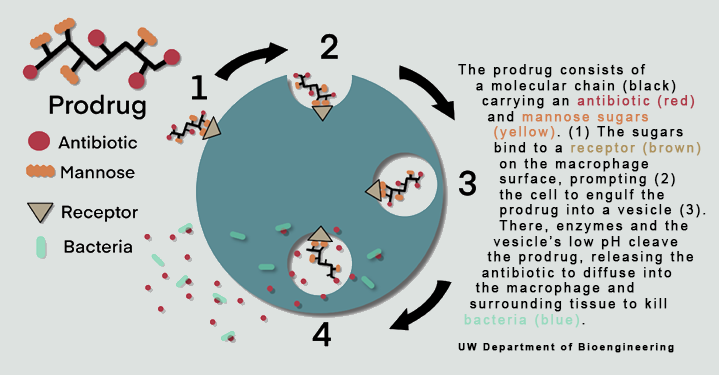
To design the prodrug, the researchers built a molecular scaffold studded with the antibiotic ciprofloxacin, attached by chemical links.
They added mannose sugars to the molecule to mimic the sugars found on bacterial surfaces. This trick prompted the macrophages to engulf the prodrug, mistaking it for a microbe. Inside the macrophage, the chemical links are undone, releasing the antibiotic within the cell.
In earlier research, the researchers had used a similar design to kill bacteria that hide inside macrophages — a survival strategy that lets pathogens evade immune attack and many antibiotics. The new study tested whether the same approach could also kill bacteria in the surrounding lung tissue, said Dr. Shawn J. Skerrett, professor in the UW School of Medicine’s Division of Pulmonary, Critical Care and Sleep Medicine.
“We had seen that the antibiotic stays within cells for an extended period of time, suggesting the macrophages might serve as a reservoir from which the antibiotic would leak out into the surrounding tissue,” Skerrett said.
To test the idea, the UW team infected mice with a lethal dose of Klebsiella pneumoniae, a bacterium that mainly infects lung tissue outside macrophages. The pathogen is notoriously hard to treat and increasingly drug-resistant.
After waiting 24 hours for the infection to take hold, researchers administered a mist containing the prodrug to the lungs of one group of mice. For comparison, other groups received ciprofloxacin alone, the inactive carrier molecule, or a salt solution.
A single dose of the prodrug cleared the infection, reduced inflammation, and significantly prolonged survival in the infected mice while the other preparations did not.
“The development of new antibiotics has stagnated over the past 50 years, so there’s a critical need to improve the delivery of existing drugs,” said senior author Patrick Stayton, UW professor of bioengineering. “Direct pulmonary delivery of targeted prodrugs for resistant infections like Klebsiella could provide a solution.”
The research team also included T. Eoin West, a professor in Pulmonary, Critical Care and Sleep Medicine, and Chemistry at the UW School of Medicine.
This work was supported by the National Institute of Allergy and Infectious Diseases (R01AI134729) and the Cystic Fibrosis Foundation. Lopez was supported by the National Science Foundation Graduate Research Fellowship Program (DGE-1762114).
For details about UW Medicine, please see our About page.