
Hope is renewed for participant in brain-implant trial
A stroke patient experiences progress while participating in a safety study of a brain-stimulation device.Media Contact: Colleen Steelquist - csteelqu@uw.edu
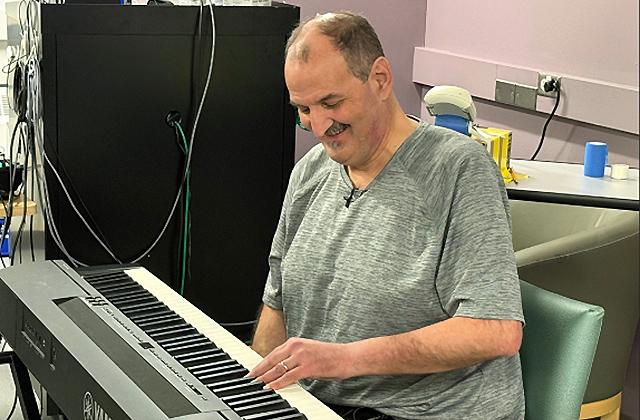
A lifelong musician, Keith McKenzie knows learning a new instrument or piece of music takes focus and patience. “It’s always difficult at first,” the 59-year-old said. “You have to keep pushing through and believe, ‘I can do this.’”
The lessons he once learned from mastering complex organ sonatas hold true for his current role: the second patient enrolled in a brain-stimulation study for stroke survivors through the University of Washington School of Medicine.
A resident of Lynden, Washington, McKenzie suffered a stroke in 2021, joining more than 795,000 people in the U.S. each year who experience strokes. Although most patients survive, the majority live with enduring disability for years.
The pandemic and additional health crises delayed McKenzie’s physical rehabilitation. He eventually underwent physical therapy, but his motor deficit persisted. With his left arm and hand immobile, he was unable to play music, work, cook or perform other daily activities without the assistance of his wife, Judy.
“My rehab had plateaued,” McKenzie said. “I was disappointed, but I figured what I have is what I’ve got.”
He hadn’t counted on the cautious optimism offered by a clinical trial. A study is being conducted by UW Medicine’s Drs. Jeffrey Ojemann, professor of neurological surgery, and Jeffrey Herron, associate professor of neurological surgery.
McKenzie joined the study after brain imaging suggested that enough of his brain was still lighting up to enable rehabilitation and future function. In January 2026, he underwent brain surgery at Harborview Medical Center.
Surgeons implanted the test device, and McKenzie begin six weeks of intensive physical therapy while the device was calibrated and emitted electrical impulses to encourage neurons to fire together, technically known as “plasticity-inducing cortical stimulation.”
McKenzie likened the exhausting daily sessions to boot camp. Physical and occupational therapist Adrià Robert Gonzalesheld up McKenzie’s left arm while McKenzie willed his fingers to comply with his intentions hundreds of times at a piano keyboard. In the first month, he couldn’t form a pincer grasp or pick up a pencil.
Fast-forward three months, and McKenzie is imagining a whole new chapter in his life.
With concerted effort, he is now slowly playing scales on the keyboard with his left hand — while keeping his arm aloft on his own — as well as cutting vegetables, zipping his jacket and tying his shoes.
“I hadn’t chopped a head of lettuce in four years,” said McKenzie, who used to work as a chef. With daily effort, his clinical team expects his hard-won gains to continue.
He’s now in the study’s “extended monitoring” phase: Neural data is being collected, but the device is no longer stimulating his brain. He’s making progress on his own. The implant will be removed in about nine months.
The device was recently implanted in a third patient, and a fourth participant is being sought. After the first four participants, the researchers will take their findings to the Food and Drug Administration with the hopes of expanding the study’s reach.
Ojemann said the path to adding this device to standard rehabilitation therapy will take many years of testing and regulatory approval. “We are so enthusiastic about the progress of our first two study patients and hope to make this widely available in the future,” he said.
“We believe this approach has the potential to help people with spinal cord injuries, traumatic brain injuries and movement disorders like Parkinson’s disease,” Herron said. “It’s incredibly exciting to unlock function in patients who have lost hope.”
McKenzie agrees. “I’ve made amazing, life-changing progress,” he said, holding back tears. “Now I can look at the future and imagine playing music with two hands again. It will take some work, but it will come.”
Related:
- In brain-implant study, patient breaks through ‘dead end’
- Video: Patient in brain device trial shows progress
For details about UW Medicine, please see our About page.