
‘Death by organ donation’ idea is nonviable, ethicist says
A published proposal to give terminally ill organ donors latitude in choosing how they die contradicts long-held ethical standards.Media Contact: Brian Donohue - 206-457-9182, bdonohue@uw.edu
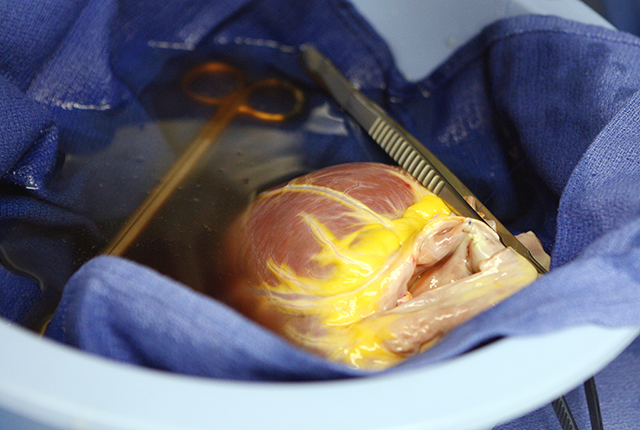
A recent essay in the New England Journal of Medicine posed an audacious idea: In countries where voluntary euthanasia is legal, terminally ill people who want to donate their organs should have the right to request “death by organ donation.”
In this scenario, a patient who has pursued and been approved for voluntary euthanasia — that is, physician-facilitated death — could elect to die by means of removing their vital organs rather than waiting for circulatory death to be confirmed first.
Doing so, the authors hypothesized, would increase the donor heart’s transplant viability by eliminating the typical five-minute waiting period between circulatory death and organ procurement, during which the lack of blood flow can damage designated donor organs, hearts in particular.
The notion of death by organ donation is “really far out there” and “not coming to a hospital near you anytime soon,” surmised Denise Dudzinski. She is a professor of bioethics and humanities at the University of Washington School of Medicine and chief of UW Medicine’s Ethics Consultation Service.
“This would be an extreme notion of euthanasia, and it might sound scary,” she said, “but since it's not happening, it’s more of an exploration of the limits of aid in dying and organ donation.”
The essay’s authors are three medical doctors, two of whom are bioethicists. They acknowledge that their proposal contradicts two tenets that have safeguarded organ donation for decades: Patients must be dead before organ procurement, and clinicians must not cause death by means of organ retrieval. In concert, these tenets compose the “dead donor rule.”
“The dead donor rule exists in part to maintain the public trust, to reassure people that organ donation will never come at the cost of a doctor's obligation to protect their patients.” — Denise Dudzinski, UW Medicine bioethicist
The authors noted that, over the years, the rule has “required reinterpretation” to accommodate increasingly robust life-sustaining interventions as well as efforts to increase the donation of solid organs that are in endlessly short supply. This idea, they said, is another opportunity for reinterpretation.
Dudzinski agreed that technology advances have regularly caused medical ethicists to reexamine what actions are appropriate as death approaches. Medical ethicists are asked, “Is it OK to turn off someone’s pacemaker or are we causing the person’s death because that device is implanted in their body? Is that euthanasia?”
The notion of death by organ donation, however, is too direct of an affront to the dead donor rule, Dudzinski said. She rebutted the suggestion that the five-minute waiting period after circulatory death should be set aside, even if it is the donor’s wish.
“The dead donor rule exists in part to maintain the public trust, to reassure people that organ donation will never come at the cost of a doctor's obligation to protect their patients,” she said. She wondered how much improvement would be seen in donor organs’ viability by casting aside the five-minute wait.
“Is it enough that we should do away with the dead donor rule? Not to me.”
The essay frames the proposal largely as a matter of patient autonomy. When a "waiver is clear, informed and voluntary," a competent patient's consent to euthanasia followed by organ donation is not so different from death by organ donation, the authors suggest. Moreover, they argue, no one suffers undue harm and the resulting benefit among the donor’s organ recipients could only be greater with this accommodation.
Dudzinski pushed back on this framing. She noted that respecting patient autonomy in medicine has traditionally meant letting patients choose from among the beneficial interventions that are available to clinicians and aligned with the patient’s stated values.
“An individual can say, ‘I want this but not that.’ But they do not have the right to say, ‘I demand some intervention that’s not on the menu,’” she said. “Healthcare has never said that a person’s autonomy has no bounds.”
In places where medical aid in dying is legal, doctors conventionally prescribe drugs that the patient takes on their own. Whether to take the drugs is the patient’s decision; death comes at the patient’s own hand, she noted. By contrast, causing a patient’s willful death by taking their organs would involve compromising the deeply held ethical commitments of surgeons and other staff.
As technology continues to evolve and society looks anew at medical aid in dying, a good-faith reexamination of the dead donor rule is OK, Dudzinski said.
“I think this is a good-faith engagement with that important ethical question. But it shouldn’t worry the public. Death by organ donation is counter to the integrity of medicine."
For details about UW Medicine, please see our About page.