
Programming proteins with viral geometry
Tiny cages could become starting points for treatment-delivery vehicles, vaccine platforms and intracellular sensors.Media Contact: Leila Gray - 206-475-9809, leilag@uw.edu
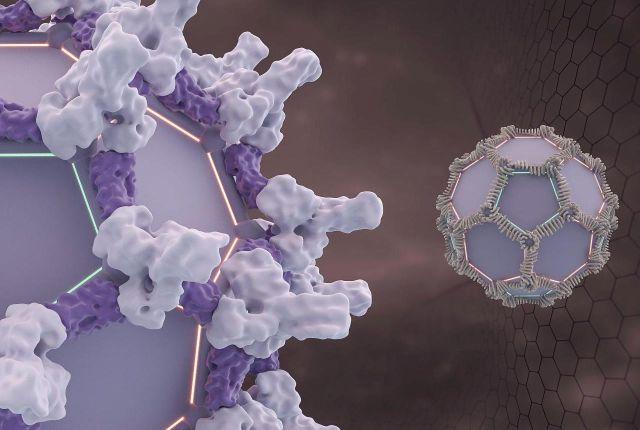
Like molecular tiles forming a curved shell, designed proteins can now self-assemble into large cages by combining pentagonal and hexagonal patterns. This is a strategy used by many natural viruses in forming their shells.
Two back-to-back papers in the journal Nature report on a major advance in computational protein design: Researchers have created large, viruslike protein cages from scratch by programming how symmetry breaks during self-assembly.
These cages could eventually become the basis for new treatment delivery vehicles (for example, to administer gene therapy to targeted cells) and possibly the foundation for vaccine platforms, intracellular sensors, programmable scaffolds and artificial compartments.
“These papers show that protein design is beginning to capture some of the architectural principles that nature uses to build at very large scales, with direct implications for both structural and synthetic biology,” said David Baker, professor of biochemistry at the University of Washington School of Medicine and director, UW Medicine Institute for Protein Design.
For decades, quasi-symmetry – referring to shapes that can almost, but not quite, be divided into identical sections – has fascinated structural biologists as one of nature’s most efficient solutions for building large molecular shells. Many viruses use this principle to construct capsids, or viral shells, from repeated protein building blocks that occupy subtly different local environments.
Related forms of symmetry-breaking appear in fullerenes (carbon structures shaped nearly like soccer balls or geodesic domes), clathrin coats (which cells build to transport cargo) and other curved molecular assemblies. Now, these studies show that quasi-symmetry can be achieved by computational protein design.
By tuning local curvature between protein building blocks, the teams created quasi-symmetric cages ranging from tens to hundreds of nanometers in diameter. These cages span the size range of many natural viruses.
Together, the one- and two-component systems produced cages reaching more than 200 nanometers across and containing hundreds to thousands of protein subunits.
Two May 20 Nature papers reported on this work:
- Design of one-component-quasi symmetric protein nanocages, with lead authors Sangmin Lee, David Chmielewski and Shunzhi Wang
- De novo design of quasi-symmetric, two component protein cages, with lead author Shunzhi Wang
In the one-component study, the team designed protein building blocks whose local geometry lies between two limiting cases: a perfectly symmetric icosahedron (three-dimensional figure with 20 flat faces) and a flat hexagonal lattice. By precisely tuning the interaction angles, the same protein sequence could form pentagonal and hexagonal local environments within one closed cage.
“Viruses taught us that perfect symmetry is not the only way to build precise molecular architecture, said Sangmin Lee, a co-lead author and former postdoctoral scholar in Baker’s lab. “A small change in local geometry can have a huge effect on the final assembly.”
“It is like changing the angle between molecular tiles and watching a flat sheet become a dome,” explained Lee, who is now an assistant professor at Pohang University of Science and Technology in South Korea.
The two-component design made the cages modular and functional. In this system, one protein component forms vertices, or points, while a second designed component forms the edges, or sides, of the cage. Changing the geometry of the edge component acts like a dial that allows the researchers to control cage size. The cages could also be functionally fused to additional protein domains for more functions.
“The exciting part of the two-component system is that it turns quasi-symmetry into a modular design platform,” said Shunzhi Wang, a former postdoctoral scholar in the Baker Lab. He is now an assistant professor at NYU Grossman School of Medicine in New York City.
“By changing the geometry of one component,” Wang said, “we can tune the size of the cage. By adding function domains, we can begin to control what the cage carries, where it goes, and how it behaves inside cells.”
Together, the studies show that computational protein design is moving beyond small, perfectly symmetric objects toward programmable mesoscale materials — structures roughly the size of viruses, vesicles, organelles and intracellular assemblies.
These cages could become starting points for new delivery vehicles, vaccine platforms, intracellular sensors, programmable scaffolds and artificial compartments. More broadly, the work suggests that protein design can engage with principles usually associated with biology and soft matter: curvature, frustration, topological defects and emergent assembly.
Led by the UW Medicine Institute for Protein Design, NYU Langone Health, and POSTECH, this research included collaborators from the Holt Lab at NYU Grossman School of Medicine and the DiMaio Lab and the Veesler Lab, both in the Department of Biochemistry, UW School of Medicine.
This work was supported by the Howard Hughes Medical Institute; The Audacious Project at the Institute for Protein Design; Burroughs Wellcome Fund; Defense Threat Reduction Agency (HDTRA1-19-1-0003); National Science Foundation (CHE-2226466); National Institutes of Health (R01AG063845); National Research Foundation of Korea; Korean Ministry of Science and ICT; Gates Foundation (INV-043758, OPP1156262); Human Frontier Science Program (RGP0061/2019); Microsoft; Spark Therapeutics (ABCA4); Nordstrom Barrier Institute for Protein Design Directors Fund; the Hypothesis Fund; and U.S. Department of Energy-supported synchrotron and structural biology resources (KP1607011, DE-SC0012704).
Written by the Institute for Protein Design.
Resources: More details on this research from the IPD.
For details about UW Medicine, please see our About page.