
Gun storage studied among adults with cognitive decline
In 7 U.S. states, older adults with cognitive decline affecting their daily activities are more likely to live with unsecured firearms.Media Contact: Susan Gregg - 206-390-3226, sghanson@uw.edu
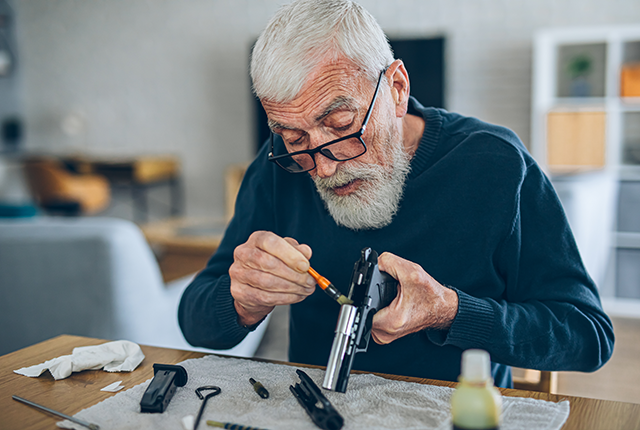
Older adults who report experiencing worsening confusion or memory loss that affects their daily activities are more likely to live in homes where firearms are not stored securely than those without such symptoms, researchers report.
“We would want people experiencing symptoms of cognitive decline to be living in homes where firearms are stored more securely than older adults without, but, unfortunately, that is not what we found,” said first author Kelsey Conrick, a postdoctoral scholar at the Center for Firearm Injury Prevention Center at the University of Washington School of Medicine.
The findings appear in JAMA Internal Medicine.
In the study, the researchers analyzed data from a survey that asked nearly 4,500 residents age 65 and older in seven states — Indiana, Louisiana, Nevada, New Jersey, New Mexico, Oregon and Virginia — whether they had firearms in and around their homes and how the guns were stored.
Guns in the home that were stored unloaded, or loaded but locked, were considered “more secure.” If, on the other hand, they were stored loaded or unlocked, the storage was considered “unsecured.”
The survey also asked the participants whether they had experienced worsening confusion or memory loss in the past year. If they answered yes, they were asked whether they were worried about the symptoms, whether the symptoms had interfered with their daily activities, and whether they had talked about the symptoms with a healthcare professional.
About 1 in 3 of those surveyed said they had a household firearm. Those with cognitive symptoms were just as likely as those without to have a firearm in the home. Those with symptoms were just as likely to have household firearms stored securely as those without. But those with more severe symptoms, described as affecting daily activities, were nearly 60% more likely to say household firearms were unsecured.
The findings suggest that little has come from efforts to encourage healthcare providers to talk with their older, cognitively diminished patients about secure gun storage, Conrick said.
To encourage more older Americans to store their firearms securely, healthcare providers should integrate secure firearm storage into routine conversations they have with older patients about driving and home safety, Conrick said. Clinicians also ought to provide gun-locking devices, she added.
“We know that these conversations paired with lock distribution are the most effective way to get more people to store firearms securely. They help people make choices about what happens to their firearms while they still can — before they get to a place where someone else has to make that choice for them,” she said.
Data for the survey came from the Behavioral Risk Factor Surveillance System, a project managed by the U.S. Centers for Disease Control and Prevention, which gathers data about health-related risk behaviors, chronic conditions and preventative services.
Ali Rowhani-Rahbar, director of the Center for Firearm Injury Prevention, was the senior author. Samantha Banks and Julia P. Schleimer were co-authors.
Written by Michael McCarthy.
For details about UW Medicine, please see our About page.